22 December 2006
Mr Wang Has Decided to Stop Blogging ...
... here. Do update your links! From January 2007 onwards, come to Mr Wang's new blog to read his new posts. See you around and Merry Christmas!
18 December 2006
Cultural Heritage Tour
So Mr and Mrs Wang decided to take the little kids to Chinatown. You know, so that they will appreciate our cultural history, Asian values and all that.
Along the way, we stopped by an McDonalds outlet for breakfast. Then just a few doors away, I noticed this shop:
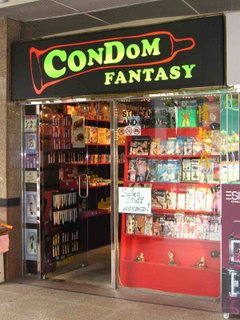
Click to enlarge. The picture, I mean.
Isn't that funny? This being a country where the government tells us that people are supposedly so conservative that we need laws that impose life imprisonment on gays.
Along the way, we stopped by an McDonalds outlet for breakfast. Then just a few doors away, I noticed this shop:

Isn't that funny? This being a country where the government tells us that people are supposedly so conservative that we need laws that impose life imprisonment on gays.
14 December 2006
The Singapore Government Plays The Religion Card Again
And basically it is a false, deceptive play. Yesterday's Straits Times carried the following article about the sex laws of Singapore. Note the part highlighted by me in orange:
The government often likes to say that things must be just so in Singapore, because we are a multi-racial, multi-religious society, and we shouldn't offend each other's sensitivities. However, as I've pointed out on many occasions, Singapore is not any more multi-racial or multi-religious than your average big modern city - for example, London, New York, San Francisco, Sydney, Jakarta or Bangkok.
Yet in none of these cities (or their respective countries) is homosexual intercourse between two consenting adults punishable with life imprisonment.
Unlike in Singapore.
The Singapore government is making religious believers in Singapore look like obsessive extremist fanatics. This is not true. Therefore what the Singapore government is doing is just not right.
+++++++++
Technorati: Singapore; religion; gay rights.
ST Dec 13, 2006
Feedback focuses on sex laws
Marital rape law reforms inadequate, say some; continued outlawing of gay sex also questioned
By Ben Nadarajan
THE private lives of Singaporeans appear to be the main concern among those who responded to the Government's call for feedback to last month's proposed changes to the Penal Code.
After a month-long feedback period which ended on Saturday, the Home Affairs Ministry received 252 responses from individuals, groups and some lawyers.
Most of the comments touched on the country's controversial sex laws, especially marital rape and gay sex..........
Another hot topic was the continued outlawing of gay sex, with at least four groups raising the matter.
The Free Community Church, which supports homosexuality, said this was 'not reflective of the moral values of today's Singapore'.
Aware also weighed in with its support to scrap section 377 (A) - the part of the Penal Code which bans acts of 'gross indecency' between men.
Calling this law an 'unwarranted intrusion' into private lives, Aware said the police should be spending time on more pressing matters than enforcing anti-gay sex laws.
The Free Community Church - which has under 100 members - also argued that singling out a certain group in society was unconstitutional as everyone should be equal before the law.
The ministry explained last month that society, especially religious groups, was not ready to tolerate gay sex.
The government often likes to say that things must be just so in Singapore, because we are a multi-racial, multi-religious society, and we shouldn't offend each other's sensitivities. However, as I've pointed out on many occasions, Singapore is not any more multi-racial or multi-religious than your average big modern city - for example, London, New York, San Francisco, Sydney, Jakarta or Bangkok.
Yet in none of these cities (or their respective countries) is homosexual intercourse between two consenting adults punishable with life imprisonment.
Unlike in Singapore.
The Singapore government is making religious believers in Singapore look like obsessive extremist fanatics. This is not true. Therefore what the Singapore government is doing is just not right.
+++++++++
Technorati: Singapore; religion; gay rights.
12 December 2006
Mr Wang's Answer to the 2% Increase in GST
Apply for the POSB Everyday credit card:
 ... buy all your groceries at Carrefour, and get a 5% rebate. And it will be as if the new GST increase never happened at all. Also, apply for the Citibank SMRT Visa Platinum Card:

....... which works like an ez-link card. Earn up to 2% rebate as you tap and go at MRT stations. For your other credit card expenditure, you earn rebates redeemable for free SMRT rides.
(It did occur to me that the number of people who qualify for platinum cards and regularly take MRT may be relatively small. The government did recently say that it wants to encourage more Singaporeans to use public transport - I wonder whether this had something to do with SMRT tying up to Citibank to launch this new credit / ez-link card ).
+++++++++
Technorati: Singapore; public transport; credit cards.
 ... buy all your groceries at Carrefour, and get a 5% rebate. And it will be as if the new GST increase never happened at all. Also, apply for the Citibank SMRT Visa Platinum Card:
....... which works like an ez-link card. Earn up to 2% rebate as you tap and go at MRT stations. For your other credit card expenditure, you earn rebates redeemable for free SMRT rides.
(It did occur to me that the number of people who qualify for platinum cards and regularly take MRT may be relatively small. The government did recently say that it wants to encourage more Singaporeans to use public transport - I wonder whether this had something to do with SMRT tying up to Citibank to launch this new credit / ez-link card ).
+++++++++
Technorati: Singapore; public transport; credit cards.
09 December 2006
A Question of Size
ST Dec 8, 2006
Oversized condoms a headache for many Indian men
NEW DELHI - Condoms designed to meet international size specifications are too big for many Indian men as their penises fall short of what manufacturers had anticipated, an Indian study has found.
The Indian Council of Medical Research, a leading state-run centre, said its initial findings from a two-year study showed 60 per cent of men in the financial capital Mumbai had penises about 2.4cm shorter than those condoms catered for.
For a further 30 per cent, the difference was at least 5cm. A poor fit meant the prophylactics often didn't do the job they were bought for, and led to some tearing or slipping off during use.
'One of the reasons for a failure of up to 20 per cent (of condoms) is the association of the size of the condom to the erect penis,' the council's Dr Chander Puri said, adding another reason was couples often put them on in a hurry.
He said many men in India, which has the world's highest HIV positive caseload, were too shy to ask for condoms.
'We need more vending machines for condoms of different sizes so people can pick a condom with confidence that is suited to their needs,' he said.
The Times of India reported the ICMR survey had studied 1,400 men between 18-50 years of age in cities like Mumbai and New Delhi as well as in rural areas in a report. It entitled its story 'Indian men don't measure up'. -- REUTERS
After a quick check on the Internet, I have ascertained that it is hardly a problem unique to India. It seems to happen all over the world - men struggle with condoms that are either too big or too small. I guess the nature of the product is that it has to fit very well - there isn't much much margin for error.
+++++++++
Technorati: India; condoms.
06 December 2006
Singaporeans Always Come ....... First?
The article below suggests a significant change in policy thinking. I could feel pleased, or I could feel skeptical. On balance, I am more inclined to adopt a "wait-&-see" attitude. I still remember distinctly the last time PM Lee made such grand pronouncements. He had told us that he would make Singapore an "open society". Heheh.
+++++++++
Technorati: Singapore; politics.
ST Dec 4, 2006
Singaporeans 'always come first'
By Zakir Hussain
THE first responsibility of the Government is to Singaporeans, Prime Minister Lee Hsien Loong said yesterday, when he announced plans to charge non-citizens more for education and health care.
He told some 1,000 People's Action Party cadres at the party's conference that 'while we have non-Singaporeans here, citizens always come first.'
Education and health are two areas in which the Government has not made a clear distinction between citizens, permanent residents and foreigners, Mr Lee added.
This will change, he declared.
In education, non-citizens will be charged higher fees, but the charges would not be set so high as to drive away foreign students.
Tuition fees for foreigners at universities and polytechnics here, for instance, are now 10 per cent above what Singaporeans and PRs pay.
As for health care, PRs will be charged more, while foreign workers are going to pay the full amount and their employers will need to buy medical insurance to protect them.
The Education and Health ministries will make these adjustments in the next few months, Mr Lee said.
'We have to treat visitors well, too, but citizens have to be treated better,' he added.
'Citizens come first in our priorities, in our thinking.'
+++++++++
Technorati: Singapore; politics.
29 November 2006
Elections Are Over. Time to Raise Ministers' Salaries!
It must be fun being a minister. Because unlike the rest of Singapore, you'll never have a bad year.ST Nov 29, 2006
Ministerial pay 'lags behind benchmark'
But decision on whether to relook salaries rests with PM, says SM Goh
By Sue-Ann Chia
BRATISLAVA (SLOVAKIA) - MINISTERS' salaries are pegged to that of the private sector, but they still lag behind the benchmark.
It is therefore likely that when civil service pay is reviewed, ministers' salaries will also be looked at, said Senior Minister Goh Chok Tong yesterday.
Last week, the Government indicated that salaries of civil servants are likely to go up as it must keep its wages competitive to recruit and retain talent in a tightening labour market.
At an interview yesterday wrapping up his visit to Europe, Mr Goh was asked about the likelihood of the pay increase, including for ministers.
He replied: 'Since the year 2000, six years have gone by with very good growth rates in some of the years, so it's time to have a look at the salary of the civil service as a whole, including the salary of the ministers.'
Right now, he said, ministers' pay packets are at 50 per cent of the benchmark, when they should be at two-thirds level.
According to the formula agreed upon for over a decade now, ministerial pay is benchmarked to the salaries of the top earners in six chosen professions. It is set at two-thirds the median income of the top eight earners in each of these six professions - that is, the pay of the individual at the mid-point of the list.
What do I mean? Well, let's say a cardiosurgeon in Singapore does very well in his career this year, makes a lot of money and is the top-earning cardiosurgeon this year.
Next year he may not do so well. Maybe he will have fewer patients. Or perhaps he just won't have so many complicated cases, so he has to charge less for doing simpler surgeries. Consequently, he will earn much less.
That's life. Some years are good, some years are not so good.
Ministers, however, have no such problem. Their salary is pegged to whoever is earning most, in a given year. When our top cardiosurgeon is earning a lot, the ministers will peg their salaries to him. When our top cardiosurgeon has a bad year, the ministers will just drop him out of the list.
They will then peg their salaries to some other doctor for whom 2007 does turn out to be a great year (eg the most successful neurosurgeon or oncologist in Singapore, for example).
Don't you just love the subtle phrasing in the following paragraph:
According to the formula agreed upon for over a decade now, ministerial pay is benchmarked to the salaries of the top earners in six chosen professions.
Heheh. Agreed upon by whom? The people of Singapore? The Opposition MPs? The NMPs? Or just between Lee Kuan Yew and his merry men in white?
+++++++++
Technorati: Singapore; politics.
27 November 2006
Mildly Sexist Letter
ST Nov 27, 2006
It's not the money that counts but the parenting
I REFER to YouthInk's discussion on family ties (ST, Nov 13).
I applaud Ng Chuin Song's philosophy that leaving kids in the hands of care-givers is unfair. This shows that she would be a responsible parent.
Hui Min wants to 'provide the best' for her children - she wants the assurance of a good balance between time and money before she 'can be convinced' to start a family.
I want to tell Hui Min that the best person to provide this assurance is herself. She is spot on in pointing out that 'it all boils down to the lifestyle we choose'.
We can spend all our lives chasing material luxuries - pursuing a Dink (double income, no kids) lifestyle in the fast lane - and end up lonely in our old age, regretting bitterly about the decision not to have kids.
Our parents raised large families on small, single incomes - but we turned out pretty okay, didn't we?
I want to assure Hui Min that not being able to afford 'musical or sporting activities' for the children does not make one a bad parent.
Think of parents who are too busy with material pursuits, and have no time for their children. Is that what kids want?
Being constantly chauffeured from school to tuition and enrichment classes?
Wouldn't they prefer to return from school to a home warmed by mum's presence?
Many well-educated women lament that their education is wasted because they have become stay-at-home mums.
But that is shallow thinking: Employment is not the ultimate goal of education.
The most important aspect of education is character building and value inculcation, which is so important for bringing up kids.
We need to be good role models for our children, and we need to impart good values to them.
Finally, there is nothing wrong with the woman holding the domestic fort while the man concentrates whole-heartedly on his career.
If he is successful, financial stability will be assured and the kids will also be well taken care of with mum around.
And don't wait until the children become older; research shows that a child's intelligence is largely set by the age of five.
Tan Chor Hoong
Mother of three children aged 12, 15 and 18
My wife has agreed, provided that I also learn to cook.
+++++++++
Technorati: Singapore; family.
Something About Drugs
There's a fairly long article in the ST today about drugs, but I just want to focus on one specific part of it. It's highlighted in orange below.
Fact 2 - Alcohol is a much more dangerous drug than cannabis.
Fact 3 - Cigarettes and alcohol are more dangerous than Ecstasy, LSD and cannabis. Click here to see.
Why then is alcohol and cigarettes legal in Singapore, when cannabis and Ecstasy are not?
Aiyah, I'm tired, so I leave it to you guys to discuss. Anyway, I mostly drink plain water and fruit juice, and I hardly ever even take a Panadol. The first and last cigarette I ever smoked was when I was eight (and I'm still angry with my grandmother for making me try that).
+++++++++
Technorati: Singapore; drugs; health.
Nov 27, 2006
Not heroin, so not harmful? That's warped logic
By Yusuf Abdol Hamid
DRUG abuse has traditionally been associated with the riff-raff of society.
Their poison of choice was primarily heroin, whose predecessor opium almost
destroyed entire generations in 19th century Asia.
Heroin has a reputation of being a 'hard drug' which ruins lives and earns its abusers long prison terms, and even the death sentence.
With Singapore's focused fight against the malaise, it comes as no surprise that there has been a steady decline in the number of heroin abusers.
Ironically, this has led to the impression among youths that drugs such as Ecstasy, ketamine and Ice are not dangerous. These drugs are not heroin, after all.
As a result, young people who take these 'party' drugs are often in denial of their addictions.
And the ease with which they obtain these substances puts a question mark over our supposedly tight border security.
They claim to smuggle them in from Malaysia, or purchase them in clandestine deals in alleyways and void decks.
So we should not be misled into thinking that the fight against drugs has been won.
A few battles may have gone our way, but the war is still as intense as ever.
Deputy Prime Minister Wong Kan Seng hit the nail on the head recently when he expressed his concern over the rise in the use of synthetic drugs.
Last year, 629 arrests were made in relation to synthetic drug use. The figure was almost 10 times the number of heroin abusers caught in the same period.
Some time ago, I was taken aback when a polytechnic classmate asked me over lunch: 'What happened just now during the lecture?'
Having seen her sitting directly in front of me in class, I thought that she was joking.
The sad truth is that she was high on a depressant known as '5', warping her sense of time and giving her no recollection of the entire lecture.It will take a huge effort, larger in scale than the campaign to counter heroin addiction in the 1970s, to rein in the ever-increasing abuse of synthetic drugs today.
The current anti-drug abuse campaigns are too general in scope and should instead focus more on the danger of synthetic drugs, since they are now much more widely abused than heroin.
Some youths, I am told, are blissfully unaware of the dangers of synthetic drugs - just like marijuana smokers who consistently reject the notion that cannabis contains high levels of cancer-causing carcinogens.
An acquaintance once related to me how he managed to muster the will to quit his dependency on Ice only after attending the funeral of a friend who had died from an overdose.
I hope it will not take more such stories to shake other abusers out of
their habit.
Fact 2 - Alcohol is a much more dangerous drug than cannabis.
Fact 3 - Cigarettes and alcohol are more dangerous than Ecstasy, LSD and cannabis. Click here to see.
Why then is alcohol and cigarettes legal in Singapore, when cannabis and Ecstasy are not?
Aiyah, I'm tired, so I leave it to you guys to discuss. Anyway, I mostly drink plain water and fruit juice, and I hardly ever even take a Panadol. The first and last cigarette I ever smoked was when I was eight (and I'm still angry with my grandmother for making me try that).
+++++++++
Technorati: Singapore; drugs; health.
24 November 2006
Singapore is World No. 3! Another Achievement.
From Aftenposten, a Norwegian newspaper:
It's interesting to note that there seems to be no correlation between the level of unfair discrimination in a country, and its level of democracy. The above study shows that where jobs are concerned, Sweden and Singapore are the world's most unfairly discriminatory countries. This other study says that Sweden is the world's most democratic nation, while Singapore is ranked dismally (84th place).
Thus like Sweden, you can be very democratic, yet very discriminatory. Or you can be like Singapore - very undemocratic, and very discriminatory.
+++++++++
Technorati: Singapore; jobs; discrimination.
Well, life is unfair. But try to stay positive. If life is unfair, it means that sometimes very good things might happen in your life that you've done absolutely nothing to deserve.40 percent feel discrimination
A new survey found that 40 percent of Norwegians feel that they have experienced discrimination when seeking work, one of the best results in the 28 nation study.
The survey by manpower company Kelly Services rated Sweden as the worst in terms of job discrimination, with nearly 100 percent of respondents saying they felt they had been unfairly treated in the past five years because of either race, age, gender or disability.
After Sweden came Thailand, Singapore, Hungary, India and Italy.
The countries where the least job discrimination was felt ranked Luxembourg as best, followed by Denmark, Hong Kong and Great Britain.
Norway did rather well, finishing 24th out of the 28 nations studied, despite having about 40 percent of 1,400 polled saying they had experienced employment discrimination in the past five years.
The most commonly given reason for job discrimination in Norway was age (22 percent), followed by gender (8 percent), race (4 percent) and disability (2 percent). Men felt more victimized than women, by 43 percent to 37 percent.
It's interesting to note that there seems to be no correlation between the level of unfair discrimination in a country, and its level of democracy. The above study shows that where jobs are concerned, Sweden and Singapore are the world's most unfairly discriminatory countries. This other study says that Sweden is the world's most democratic nation, while Singapore is ranked dismally (84th place).
Thus like Sweden, you can be very democratic, yet very discriminatory. Or you can be like Singapore - very undemocratic, and very discriminatory.
+++++++++
Technorati: Singapore; jobs; discrimination.
Seditious Letter in the Straits Times
Goodness. Everyone knows that gambling is good for the soul. Why else would the PAP government want to build all those casinos on Sentosa? Ms Angela Lee ought to be arrested for writing such a seditious letter to the Straits Times. We should encourage young Singaporeans to be more entrepreneurial, to take more risks and to explore alternative careers in mahjong and jackpot.
+++++++++
Technorati: Singapore.
ST Forum Nov 24, 2006
Play poker as a career? Fat chance
THE media attention given to the recent poker tournament held here and glamorising of poker playing as a profession are total unnecessary.
It gave many, especially the young, the false impression and hope that they could make money by playing poker well.
To say that playing poker is a skill and not a gamble is definitely not the whole truth. As the players have no control over what cards they get, it is still a game of chance. Skill, if any, comes with practice and, not surprisingly, at a heavy price.
Let it be said that for every 'successful' poker player, there are thousands of unsuccessful ones, adding to our social burden of broken families and bankruptcies. The media should have pointed out the fallacy of poker playing as a career - for most people.
Angela Lee Soon Lee (Mdm)
+++++++++
Technorati: Singapore.
23 November 2006
The Myth of Religious Harmony in Singapore
Yawning Bread is a brave man. Braver than Mr Wang.
Yawning Bread has just written an essay entitled "The Niqab and the Freedom of Religion - is there any logical reason why people speak of the freedom of religion?".
It is written in typical Yawning Bread style - articulate, intelligent and very well-reasoned. Nevertheless it takes a certain degree of courage to write it (even though most of his examples are taken from outside Singapore). For the essay addresses a topic that is quite taboo in Singapore - religion.
Jus think Sedition Act; Internal Security Act; Maintenance of Religious Harmony Act; and the Penal Code. There are probably one dozen different ways you could get arrested or detained in Singapore, for talking about religion in the "wrong" way.
We like to say that there is religious harmony in Singapore. Actually, that depends on your understanding of the word "harmony".
I would not say that there is religious "harmony" in Singapore. I would say that there is religious tolerance. In Singapore, there is undeniably a high degree of mutual religious tolerance, instilled by the efforts of the Singapore government.
Those efforts work on this basic principle - if you offend someone else's religion, you're gonna get it from the government.
Thus there is mutual tolerance. Not harmony. There is the absence of inter-religious violence, but not the presence of inter-religious understanding. Can we make that further leap? It would be a great achievement indeed.
+++++++++
Technorati: Singapore; religion.
Yawning Bread has just written an essay entitled "The Niqab and the Freedom of Religion - is there any logical reason why people speak of the freedom of religion?".
It is written in typical Yawning Bread style - articulate, intelligent and very well-reasoned. Nevertheless it takes a certain degree of courage to write it (even though most of his examples are taken from outside Singapore). For the essay addresses a topic that is quite taboo in Singapore - religion.
Jus think Sedition Act; Internal Security Act; Maintenance of Religious Harmony Act; and the Penal Code. There are probably one dozen different ways you could get arrested or detained in Singapore, for talking about religion in the "wrong" way.
We like to say that there is religious harmony in Singapore. Actually, that depends on your understanding of the word "harmony".
I would not say that there is religious "harmony" in Singapore. I would say that there is religious tolerance. In Singapore, there is undeniably a high degree of mutual religious tolerance, instilled by the efforts of the Singapore government.
Those efforts work on this basic principle - if you offend someone else's religion, you're gonna get it from the government.
Thus there is mutual tolerance. Not harmony. There is the absence of inter-religious violence, but not the presence of inter-religious understanding. Can we make that further leap? It would be a great achievement indeed.
ST Nov 22, 2006
Singapore may host world interfaith dialogue, says SM
SENIOR Minister Goh Chok Tong wants Singapore to be a venue for interfaith dialogue, bringing religious leaders together to promote greater understanding of each other's faith.
Mr Goh raised the issue of such a meeting with the Vatican's Secretary of State Cardinal Tarcisio Bertone who was 'very supportive' of the idea when they met in Rome on Monday.
'I suggested that since this is a troubled world, we should think of organising an interfaith dialogue in Singapore,' Mr Goh told Singapore media after the half-hour meeting.
Standing just outside the Vatican's St Peter's Square, he said Singapore is an ideal venue for such a meeting late next year or in early 2008 as it is a multi-religious society where people live in harmony.
'If we can have interfaith dialogue initiated by Singapore, the Vatican, plus a few other heads of religion, then we can contribute to a better understanding between people of different religions,' he added.
Singapore has been spreading the word of wanting to host an interfaith dialogue, an idea that Foreign Affairs Minister George Yeo surfaced a few months ago.
In his ministry's addendum to the President's address at the opening of Parliament earlier this month, Mr Yeo said Singapore is committed to promoting interfaith dialogue in the coming years.
+++++++++
Technorati: Singapore; religion.
21 November 2006
Who Are We Helping?
The GST hike is a hot topic. However, so far I have said little. The reason is that I am ambivalent about it.
According to PM Lee, the GST hike will enable the the government to do more to help poor Singaporeans. This implies that without the GST hike, the government is unable to help poor Singaporeans. I don't believe this.
But anyway, if the government does really fulfil its promise to help poor Singaporeans, then I think that the GST hike is a good thing. The real question, as I see it, is whether the government will do as promised.
Am I too cynical? You'll have to pardon me. As an example of the establishment's mindset, take a look at this:
Yet the government tells you that to be able to help poor Singaporeans, it needs to raise your GST. How cheeky.
What does NUS have to say in its own defence?
Why should I instead use my money to help a foreigner get his degree in NUS?

Some foreigners who really need your help.
+++++++++
Technorati: Singapore; NUS; education.
According to PM Lee, the GST hike will enable the the government to do more to help poor Singaporeans. This implies that without the GST hike, the government is unable to help poor Singaporeans. I don't believe this.
But anyway, if the government does really fulfil its promise to help poor Singaporeans, then I think that the GST hike is a good thing. The real question, as I see it, is whether the government will do as promised.
Am I too cynical? You'll have to pardon me. As an example of the establishment's mindset, take a look at this:
ST Nov 21, 2006
Foreigners get 4 in 10 bursaries given by NUS this year
But S'pore students come first, it says in response to some rumblings
By Education Correspondent, Sandra Davie
FOUR in 10 bursaries awarded by the National University of Singapore (NUS) this year went to foreigners, a move by the university to signal that it embraces talented students from anywhere.
But Singapore students will be catered for first, before the funds go out to foreign students.
The NUS financial aid office has offered 1,500 bursaries so far this year, with 60 per cent, or 900, going to Singaporeans. No local applicant who met the eligibility criterion of per capita monthly household income of up to $900 was turned away.
They were awarded bursaries ranging from $1,000 to $2,000.
Foreigners who could show proof of hardship took the rest of the bursaries, with each getting about $300 less than their local counterparts.
The move by NUS has led to rumblings among some alumni, students and parents, who called The Straits Times to complain about what they see as an 'inappropriately large number of bursaries' going to foreigners.
Their beef is that the bursaries are funded out of the NUS budget, which comes from taxpayers, and alumni contributions, which come mostly from Singaporeans, so why should so much of it go to foreigners, they ask.
Yet the government tells you that to be able to help poor Singaporeans, it needs to raise your GST. How cheeky.
What does NUS have to say in its own defence?
Whatever. You can bet your bottom cent that Mr Wang isn't ever going to donate a cent to his beloved alma mater NUS. Why should I? Even if I had a burning desire to help foreigners, I'd rather donate my money to Cambodian orphans, or Indonesian tsunami victims, or Afghan earthquake survivors.When asked to comment, NUS reiterated that local students are given priority for bursaries, noting that all Singapore applicants who applied received them.
Foreign students also get less than locals, it said.
NUS vice-provost Lily Kong said its bursary scheme is in line with the university's commitment to ensure that no student is denied a university education due to financial difficulty.
Why should I instead use my money to help a foreigner get his degree in NUS?
Some foreigners who really need your help.
+++++++++
Technorati: Singapore; NUS; education.
20 November 2006
NS and Employment

Recognise him?
See article below - here is a recurring problem that will grow worse and worse over the years, as the number of PRs, foreigners and adults-turned-new-citizens steadily grows in Singapore.
The writer is wrong to think that only small companies may tend to avoid hiring Singaporean men. The same problem would exist for any job where the individual performs a specialised function such that it isn't easy for someone else to just step in halfway and take over for two or three weeks.
I myself was once asked point-blank at a job interview what kind of SAF vocation I had, how often I would be called up each year, and for how long etc. Fortunately I am blessed with a congenital heart disorder and need not do reservist duties any more.
ST Nov 20, 2006
NS stint may hinder job prospects for S'poreans
WHEN I started business in the motor trade a couple of years ago, I was surprised that many companies are reluctant to employ Singaporeans for several reasons. One of the main ones is that most male Singaporeans have to serve two to three weeks' reservist training every year.
As a Singaporean, I understandably want to support my own people and give our men an opportunity. So my company went against the grain by employing one permanent resident and one Singaporean where most other companies go with PRs.
Both were equally hard working and resourceful. However, the Singaporean had in-camp training and when he failed his individual physical proficiency test (IPPT), he had to go for further training which meant that he had to leave work early. No such thing with PRs.
Although the Government reimburse the employee during reservist training, a company employs someone because of his contribution to its profitability. Does the Government take loss of business into consideration?
Small companies do not have the financial strength to bear the loss. Does this mean male Singaporeans can work only in large companies?
+++++++++
Technorati: Singapore; national service.
On Emigration
 In the Straits Times today, some writers discuss a July survey which showed that 53% of young Singaporeans would consider emigration. Can Singapore depend on its youth to stay here and take ownership of the country, our ever-complaining MPs lament in Parliament.
Actually I wonder why young Singaporeans are being singled out in particular. After all, Singaporeans in just about every age group are emigrating. This article, written in 2005, cites various sources and tells us that:
* Every year, 6,000 to 7,000 Singaporeans leave to settle down overseas, including many professionals. This is 15% of today's annual births, probably the highest proportion in the world.On a separate note, I do not really believe that the government is really concerned about the high emigration rate, as long as it is able to continue attracting sufficient numbers of foreigners to Singapore.
* One survey has put Singapore's average outflow at 26.11 migrants per 1,000 citizens, the second highest in the world - next only to East Timor (51.07).
* Nearly half of all Singaporeans do not think they need to be a resident to be emotionally rooted to the country.
* Six out of 10 undergraduates said they wanted to go abroad to live or work mostly for better economic and job prospects, and enjoy a higher quality of life with less stress.
* An ACNielsen poll showed 21% of Singaporeans, mainly professionals, were considering emigration, half opting for Australia and New Zealand.
* Between 100,000 and 150,000 Singaporeans are studying, working or in business in foreign countries; leaders fear that many of them will not return.
+++++++++
Technorati: Singapore; emigration.
19 November 2006
Another Politician Joins The Blogosphere
Yaw Shin Leong was one of those WP youngsters who ran against PM Lee Hsien Loong in Ang Mo Kio GRC. Check out his blog.
See his blogroll too - he refers to "Mr Wong Bakes Good Karma". Heheh.
See his blogroll too - he refers to "Mr Wong Bakes Good Karma". Heheh.
A Couple of Changes
So I've decided to change a couple of things about this blog.
Firstly, the range of topics will be wider. Basically I'll just blog about anything I feel like. I won't be sticking just to social, economic, political and legal issues in Singapore.
Secondly, irrelevant comments will simply be deleted. Also, please don't cut & paste entire articles from elsewhere into my comment section. Just leave a hyperlink. I hate clutter.
Thirdly, since I get so much traffic, I shall put it to good use by giving more publicity to worthy causes and charitable events. So if you're organising something, feel free to drop me an email (mrwangsaysso@gmail.com).
Firstly, the range of topics will be wider. Basically I'll just blog about anything I feel like. I won't be sticking just to social, economic, political and legal issues in Singapore.
Secondly, irrelevant comments will simply be deleted. Also, please don't cut & paste entire articles from elsewhere into my comment section. Just leave a hyperlink. I hate clutter.
Thirdly, since I get so much traffic, I shall put it to good use by giving more publicity to worthy causes and charitable events. So if you're organising something, feel free to drop me an email (mrwangsaysso@gmail.com).

17 November 2006
Kids Stuff
PAP MP Michael Palmer spoke in Parliament about the importance of a quality pre-school education. The text is available somewhere on the P65 blog.
Palmer refers to scientific discoveries about human brain development. The quality and quantity of stimulation that a child receives in the first six years of his life will play a huge factor in determining his mental capabilities ... for the rest of his life.
This has got to do with the actual physical growth of the brain (neurons, dendrites, synapses and so on) which is influenced by the external stimulation. Past the age of six, the brain has done most of its growing, and the possibility of further huge gains in mental processing capabilities become much more limited.
Palmer therefore argues for the Singapore government to place more emphasis on pre-school education.
The topic is close to my heart because I am a daddy of two young children. In fact, ever since I became a father, child development and psychology has become one of my pet topics.
The scientific discoveries are nothing new, and are furthermore a continual work-in-progress. Gaps and unknowns are still being researched. But overall it is fair to say that the first six years of the child's life really matter a lot, in determining his ultimate capabilities.
Palmer's post on P65 attracted a worried comment from one concerned citizen. An excerpt:
What should a quality preschool education be like? If you go by what the scientific discoveries tell you, it should be fun. It should be enjoyable. Kids should love it.
If they don't, then it isn't a quality education. Why? Because little children learn through play. That's how you engage their higher cognitive centres. If they feel stressed or frightened, that means they're operating from the reptilian cortex (the part of the brain that generates the "fight-or-flight" response to danger). And that's simply not where we need the brain growth to be.
In other words, if your little kids feel stressed in class, then the teacher sucks. And your kids aren't getting a quality preschool education. Quality learning only happens when the kids are having fun.
That's why in a quality preschool, you expect no homework. Your kids want to go to school. The classroom has toys, posters, art materials, musical instruments - and plenty of space for the kids to run around. The kids learn not by sitting down and memorising, but through drama, games, singing, dancing, art & craft, group play and hands-on experiments. The teachers are caring, humorous and smiling.
Lessons are designed to engage several of the multiple intelligences at a time. The environment is not competitive, because nothing is graded, nothing is given an A or B or F. Every lesson is designed to be its own reward. Everything should be fun.
So I hope that the Singapore government will promote quality preschool education. We need many, many more trained preschool teachers who know what quality is all about. Precisely because Singapore is already too competitive. We need to stop the current education system from destroying our little kids' natural curiosity and love for learning. We want things to be fun.
+++++++++
Technorati: Singapore; education.
Palmer refers to scientific discoveries about human brain development. The quality and quantity of stimulation that a child receives in the first six years of his life will play a huge factor in determining his mental capabilities ... for the rest of his life.
This has got to do with the actual physical growth of the brain (neurons, dendrites, synapses and so on) which is influenced by the external stimulation. Past the age of six, the brain has done most of its growing, and the possibility of further huge gains in mental processing capabilities become much more limited.
Palmer therefore argues for the Singapore government to place more emphasis on pre-school education.
The topic is close to my heart because I am a daddy of two young children. In fact, ever since I became a father, child development and psychology has become one of my pet topics.
The scientific discoveries are nothing new, and are furthermore a continual work-in-progress. Gaps and unknowns are still being researched. But overall it is fair to say that the first six years of the child's life really matter a lot, in determining his ultimate capabilities.
Palmer's post on P65 attracted a worried comment from one concerned citizen. An excerpt:
Dear Mr Palmer,I absolutely empathise with the sentiments of the above post. However, I also absolutely disagree with its substance. Let me explain.
I feel strongly that putting more emphasis on pre-school education will be detrimental to our nation. Yes, perhaps children do benefit from an early education, but I think that you are neglecting several consequences that will arise should your suggestions be put in place. First and foremost, Singapore is a competitive culture. We have seen this time and again when parents pressure their children to get into a good school by attaining high scores in their exams. This pressure starts at the Primary level, where parents already compete with each other to get their children into prestigious schools. Put more emphasis on pre-school education, and you will see the pressure on children jump to an all time high .....
It is a tragedy that Singaporean school children are so pressured already; but it is a necessary evil. Already, children commit suicide because of stress-related problems. Let us not impose these pressures on the young until they are truly ready. Please, let children be children. No good can come, in my humble opinion, of turning them into competitive academic machines.
What should a quality preschool education be like? If you go by what the scientific discoveries tell you, it should be fun. It should be enjoyable. Kids should love it.
If they don't, then it isn't a quality education. Why? Because little children learn through play. That's how you engage their higher cognitive centres. If they feel stressed or frightened, that means they're operating from the reptilian cortex (the part of the brain that generates the "fight-or-flight" response to danger). And that's simply not where we need the brain growth to be.
In other words, if your little kids feel stressed in class, then the teacher sucks. And your kids aren't getting a quality preschool education. Quality learning only happens when the kids are having fun.
That's why in a quality preschool, you expect no homework. Your kids want to go to school. The classroom has toys, posters, art materials, musical instruments - and plenty of space for the kids to run around. The kids learn not by sitting down and memorising, but through drama, games, singing, dancing, art & craft, group play and hands-on experiments. The teachers are caring, humorous and smiling.
Lessons are designed to engage several of the multiple intelligences at a time. The environment is not competitive, because nothing is graded, nothing is given an A or B or F. Every lesson is designed to be its own reward. Everything should be fun.
So I hope that the Singapore government will promote quality preschool education. We need many, many more trained preschool teachers who know what quality is all about. Precisely because Singapore is already too competitive. We need to stop the current education system from destroying our little kids' natural curiosity and love for learning. We want things to be fun.
+++++++++
Technorati: Singapore; education.
More on Life and Money
ST Forum Nov 17, 2006The letter doesn't say exactly what AIA product Mr Ishwaran bought. But Mr Wang can hazard a few guesses as to what might have happened here. Here goes:
50% less returns from investment
IN NOVEMBER 2002 I invested $10,000 in an AIA investment scheme for five years, using funds from my CPF Special Account.
Recently, AIA informed me that, as of this month, the amount earned on the investment after four years is $800-plus.
I wonder how much the company will pay me on maturity next November - maybe another $200 more.
The CPF Special Account pays 4 per cent interest and had I not taken out my funds I would have earned $2,000 in five years.
On the other hand, AIA will pay me only about $1,000. When the account was opened, I was given to understand that the returns would be about 6 per cent.
If I close the account now, I may incur a penalty.
There should be rigorous checks and controls on companies seeking to tap CPF members' Special Account funds.
N. Ishwaran
Firstly, Mr Ishwaran thought he invested $10,000. Actually, he probably invested less than that. $10,000 was deducted from his CPF account, but a good chunk of it went to the insurance agent's pocket, as commission.
Another chunk of the $10,000 went towards paying the pure premium for his life insurance. In other words, AIA had promised to pay him $X if he dies anytime between 2002 to 2007. In return for this promise, Ishwaran has to pay AIA.
A third portion of his $10,0000 went to his agent bank. When you wish to invest your CPF money, you need to open an account with either DBS, OCBC or UOB. Then whenever you do something (like buy into an AIA investment scheme with your CPF Special Account money), the agent bank charges a fee.
After deducting these three payments, we see that Ishwaran actually invested quite a lot less than $10,000. So he really can't expect such high returns.
Poor Mr Ishwaran. If only he'd understood all that, before he invested.
More generally - the money in your CPF Special Account earns 4% per annum. This is a good return, considering that the return is guaranteed, by none other than the government of Singapore (a triple-A rated entity). In the financial world, this kind of investment is considered "risk-free".
If you choose to invest your CPF Special Account money elsewhere, you could possibly get returns high than 4%. On the other hand, you also have to take the risk not just of earning less than 4% (which is what happened to Mr Ishwaran), but of losing part of your principal sum. For most people, I would say that the sensible thing to do is leave your money in your CPF Special Account.
Bear in mind that every sensible investment portfolio needs some diversification. That simply means that you invest in different things, some of which carry lower risks and lower potential returns, and some of which carry higher risks and higher potential returns.
Therefore even if you consider 4% low, you can nevertheless leave your CPF Special Account money alone and think of it as the "low risk" portion of your overall portfolio. You can then allocate a greater part of your non-CPF investment towards riskier investments (such as equities).
Personally I think that 4% is great for a risk-free investment.
See also Mr Wang's recent other post about insurance.
Some people like to use their CPF OA and SA to buy insurance because it's money they can't otherwise use anyway. This is rather naive thinking (unless you need insurance and you really can't afford to pay for it with your own cash). Your CPF isn't doing nothing. It's growing and it's meant for your retirement.
I want to reiterate my view that insurance and investment generally are a poor mix. Treat them separately. Buy insurance for protection's sake; invest the rest to make money. Mr Ishwaran can still achieve outstanding profits on his AIA product; however to do that, he has to die immediately. I don't think he would like that.
+++++++++
Technorati: Singapore; financial planning .
More About the Complaining MPs
ST Online Forum, Nov 17, 2006
MP's remarks about 'complaining' S'poreans are unfair
I agree fully with the views expressed by Mr Benny Tan Seng Hee and Mr Wang Tiancheng, who reacted to Dr Mohd Maliki Osman's statement that Singapore is becoming a nation of problem-identifiers, not problem-solvers.
As an ordinary Singapore citizen, I would like to state that words cannot describe my disappointment with Dr Maliki.
I would take this opportunity to raise some questions and seek further clarifications on his statements in Parliament.
Isn't it ironic that Dr Maliki, an MP and community leader who was elected by Singaporeans who believe and have trust in his abilities to serve them, complain about Singaporeans' complaints?
I hope that it is not a sign that the MP is getting sidetracked from the tasks at hand by making statements and raising issues which do not significantly benefit anyone.
Exactly what is wrong with Singaporeans requesting assistance from the authorities when there is a problem?
Isn't this the most logical and civilised thing to do? Dr Maliki cited an example of residents calling their town councils when the lift landings are dirty. Is it wrong for residents who contribute monthly to the conservancy and maintenance costs of the estate to do so?
I strongly disagree with the statement that by 'giving feedback' to government agencies, many adults are bad role models for their children.
Filing complaints or 'giving feedback' is a legal and peaceful means of seeking redress, change and improvements.
This process educates the young to respect the nation's laws and raises awareness on the proper channels that are available to citizens. This will also provide them with the assurance that their views will not go unheard.
Dr Maliki's labelling of Singaporeans as 'problem identifiers' and 'problem referrers' is condescending, unfair and uncalled for. As far as I'm concerned, these negative labels have the potential to cause many Singaporeans to be upset, especially those who have voted for him to represent them in Parliament.
With all due respect, Dr Maliki should realise that delivering promises and staying focused on serving the needs of Singaporeans, regardless of how big or small the issue is, is part and parcel of his challenges as an elected Member of Parliament.
I invite Dr Maliki to clarify and explain his statements.
Mohammad Fahmi Bin Ahmad Abu Bakar
+++++++++
Technorati: Singapore; Parliament.
Backgrounders: The earlier story..
Subscribe to:
Posts (Atom)